
Template:NMEA2000: Difference between revisions
Tag: Reverted |
No edit summary |
||
| (36 intermediate revisions by the same user not shown) | |||
| Line 6: | Line 6: | ||
=== Method 1: M12 5-Pin connector === | === Method 1: M12 5-Pin connector === | ||
[[File:NMEA2000 to FMx650 Manual - Micro C, Macro C, T-connector.png|650px|right|link=Special:Redirect/file/NMEA2000 to FMx650 Manual - Micro C, Macro C, T-connector.png]] | |||
<table class="nd-othertables_2" style="width:30%;"> | <table class="nd-othertables_2" style="width:30%;"> | ||
| Line 33: | Line 34: | ||
</tr> | </tr> | ||
</table> | </table> | ||
<br><br><br><br><br><br><br><br><br><br><br><br><br><br> | |||
=== Method 2: NMEA 2000 Backbone wire connection === | === Method 2: NMEA 2000 Backbone wire connection === | ||
Connect directly to the backbone using: | Connect directly to the backbone using: | ||
| Line 39: | Line 40: | ||
* Power source connection | * Power source connection | ||
* Ground connection | * Ground connection | ||
[[File:NMEA2000 to FMx650 Manual - backbone.png|right|link=Special:Redirect/file/NMEA2000 to FMx650 Manual - backbone.png]] | |||
'''Important Note:''' The {{{model}}} is not a waterproof device. We strongly recommend installing it inside a custom waterproof enclosure to protect it from marine environments. | '''Important Note:''' The {{{model}}} is not a waterproof device. We strongly recommend installing it inside a custom waterproof enclosure to protect it from marine environments. | ||
| Line 47: | Line 51: | ||
'''Baudrate:''' The NMEA 2000 system operates exclusively at 250 kbps.<br> | '''Baudrate:''' The NMEA 2000 system operates exclusively at 250 kbps.<br> | ||
'''Termination Resistance:''' 120Ω termination resistors must be installed at both ends of the network.<br> | '''Termination Resistance:''' 120Ω termination resistors must be installed at both ends of the network.<br> | ||
'''{{{model}}} Resistance Setting:''' Disable the internal CAN resistance on the | '''{{{model}}} Resistance Setting:''' Disable the internal CAN resistance on the {{{model}}} to ensure proper network operation. | ||
[[File:NMEA200 Resistance Setting.png|300px]] | |||
=== CAN Bus configuration === | === CAN Bus configuration === | ||
| Line 57: | Line 62: | ||
# Navigate to the NMEA2000 tab. | # Navigate to the NMEA2000 tab. | ||
# Configure the CAN source according to your physical connection (CAN1 or CAN2). | # Configure the CAN source according to your physical connection (CAN1 or CAN2). | ||
[[File:NMEA2000 CAN source.png|350px]] | |||
The '''“Engine Instance ID”''' parameter allows selection of a value from 0 to 255. However, according to the NMEA2000 protocol specification, the following values are reserved and should not be used: | The '''“Engine Instance ID”''' parameter allows selection of a value from 0 to 255. However, according to the NMEA2000 protocol specification, the following values are reserved and should not be used: | ||
| Line 76: | Line 82: | ||
* The system supports monitoring up to 4 engines simultaneously. | * The system supports monitoring up to 4 engines simultaneously. | ||
* Configure each engine's parameters individually as needed. | * Configure each engine's parameters individually as needed. | ||
[[File:NMEA2000 IO.png|500px]] | |||
''As an example, the following data is received:''<br> | <big>''As an example, the following data is received:''<br> | ||
'''0x11 0x6A 0x19 0x00 0x00 0x00 0x00 0x00'''<br> | </big>'''0x11 0x6A 0x19 0x00 0x00 0x00 0x00 0x00'''<br> | ||
* '''Instance''' = (0x11 & 0xF0) >> 4 = 0x10 >> 4 = 1 → Data will be written to Fuel Fluid Level #2 | * '''Instance''' = (0x11 & 0xF0) >> 4 = 0x10 >> 4 = 1 → Data will be written to Fuel Fluid Level #2 | ||
* '''Type''' = 0x11 & 0x0F = 0x01 = 1 | * '''Type''' = 0x11 & 0x0F = 0x01 = 1 | ||
| Line 84: | Line 92: | ||
* '''Value''' = 6500 * 4 / 1000 = 26 = 0x1A | * '''Value''' = 6500 * 4 / 1000 = 26 = 0x1A | ||
If the “low level” or “high level” parameters are not set, the fluid level is calculated as: | If the “low level” or “high level” parameters are not set, the fluid level is calculated as:<br> | ||
'''Fluid Level | '''Fluid Level = (Type << 12) | Value<br> | ||
= 0x1000 | 0x001A = 0x101A (Decimal: 4122) | '''= 0x1000 | 0x001A = 0x101A (Decimal: 4122)'''<br> | ||
[[File:NMEA2000 Fuel level 2 screen one.png|500px]]<br> | |||
'''But if “low level” or “high level” would be set, Type data will be ignored.'''<br> | |||
[[File:NMEA2000 Fuel level 2 screen high level.png|500px]]<br> | |||
== AVL ID lists == | |||
=== General AVL ID Lists === | |||
<table class="nd-othertables_2" style="width:55%; border-collapse: collapse;"> | |||
<tr> | |||
<th style="width:20%; vertical-align: middle; text-align: center;">Parameter name</th> | |||
<th style="width:40%; vertical-align: middle; text-align: center;">AVL ID</th> | |||
</tr> | |||
<tr style="text-align: center; vertical-align: center;"> | |||
<td style="vertical-align: middle; text-align: center;">Fuel Fluid Level</td> | |||
<td style="text-align: center;">10850</td> | |||
</tr> | |||
<tr style="text-align: center; vertical-align: center;"> | |||
<td style="vertical-align: middle; text-align: center;">Oil Fluid Level</td> | |||
<td style="text-align: center;">10851</td> | |||
</tr> | |||
<tr style="text-align: center; vertical-align: center;"> | |||
<td style="vertical-align: middle; text-align: center;">Oil Pressure</td> | |||
<td style="text-align: center;">10852</td> | |||
</tr> | |||
<tr style="text-align: center; vertical-align: center;"> | |||
<td style="vertical-align: middle; text-align: center;">Oil Temperature</td> | |||
<td style="text-align: center;">10853</td> | |||
</tr> | |||
<tr style="text-align: center; vertical-align: center;"> | |||
<td style="vertical-align: middle; text-align: center;">Engine Temperature</td> | |||
<td style="text-align: center;">10854</td> | |||
</tr> | |||
<tr style="text-align: center; vertical-align: center;"> | |||
<td style="vertical-align: middle; text-align: center;">Alternator Voltage</td> | |||
<td style="text-align: center;">10855</td> | |||
</tr> | |||
<tr style="text-align: center; vertical-align: center;"> | |||
<td style="vertical-align: middle; text-align: center;">Fuel Rate</td> | |||
<td style="text-align: center;">10856</td> | |||
</tr> | |||
<tr style="text-align: center; vertical-align: center;"> | |||
<td style="vertical-align: middle; text-align: center;">Engine Hours</td> | |||
<td style="text-align: center;">10857</td> | |||
</tr> | |||
<tr style="text-align: center; vertical-align: center;"> | |||
<td style="vertical-align: middle; text-align: center;">Coolant Pressure</td> | |||
<td style="text-align: center;">10858</td> | |||
</tr> | |||
<tr style="text-align: center; vertical-align: center;"> | |||
<td style="vertical-align: middle; text-align: center;">Fuel Pressure</td> | |||
<td style="text-align: center;">10859</td> | |||
</tr> | |||
<tr style="text-align: center; vertical-align: center;"> | |||
<td style="vertical-align: middle; text-align: center;">Engine Status 1 Warning</td> | |||
<td style="text-align: center;">10860</td> | |||
</tr> | |||
<tr style="text-align: center; vertical-align: center;"> | |||
<td style="vertical-align: middle; text-align: center;">Engine Status 2 Warning</td> | |||
<td style="text-align: center;">10861</td> | |||
</tr> | |||
<tr style="text-align: center; vertical-align: center;"> | |||
<td style="vertical-align: middle; text-align: center;">Engine Load</td> | |||
<td style="text-align: center;">10862</td> | |||
</tr> | |||
<tr style="text-align: center; vertical-align: center;"> | |||
<td style="vertical-align: middle; text-align: center;">Engine Torque</td> | |||
<td style="text-align: center;">10863</td> | |||
</tr> | |||
<tr style="text-align: center; vertical-align: center;"> | |||
<td style="vertical-align: middle; text-align: center;">Water Depth Transducer</td> | |||
<td style="text-align: center;">10864</td> | |||
</tr> | |||
<tr style="text-align: center; vertical-align: center;"> | |||
<td style="vertical-align: middle; text-align: center;">Trip Fuel Used</td> | |||
<td style="text-align: center;">10865</td> | |||
</tr> | |||
<tr style="text-align: center; vertical-align: center;"> | |||
<td style="vertical-align: middle; text-align: center;">Distance To Empty</td> | |||
<td style="text-align: center;">10866</td> | |||
</tr> | |||
<tr style="text-align: center; vertical-align: center;"> | |||
<td style="vertical-align: middle; text-align: center;">Trip Run Time</td> | |||
<td style="text-align: center;">10867</td> | |||
</tr> | |||
</table> | |||
== AVL ID list == | === AVL ID list for engine selection === | ||
<table class="nd-othertables_2" style="width:100%; border-collapse: collapse;"> | <table class="nd-othertables_2" style="width:100%; border-collapse: collapse;"> | ||
<tr> | <tr> | ||
| Line 192: | Line 286: | ||
</tr> | </tr> | ||
</table> | </table> | ||
[[Category:{{{model}}} Manual]] | |||
Latest revision as of 15:47, 31 October 2025
Introduction
NMEA 2000 (NMEA2k) is a marine communication standard built on the CAN bus based on SAE J1939 standard. It defines a common network for sharing data between navigation, engine, sensor, and monitoring devices on a vessel. By connecting the {{{model}}} into the marine communication line, depending on the boat equipment you can receive data from the onboard systems such as water depth, wind direction, wind speed etc. as well as engine data (RPM, Oil pressure, fuel rate etc.) from up to 4 engines and information about up to 16 Fluid tanks (Fuel tank 1/2, Fresh water tank, Waste water tank, Oil etc.).
Connection methods
The {{{model}}} device can be connected to your NMEA 2000 network using one of two methods:
Method 1: M12 5-Pin connector
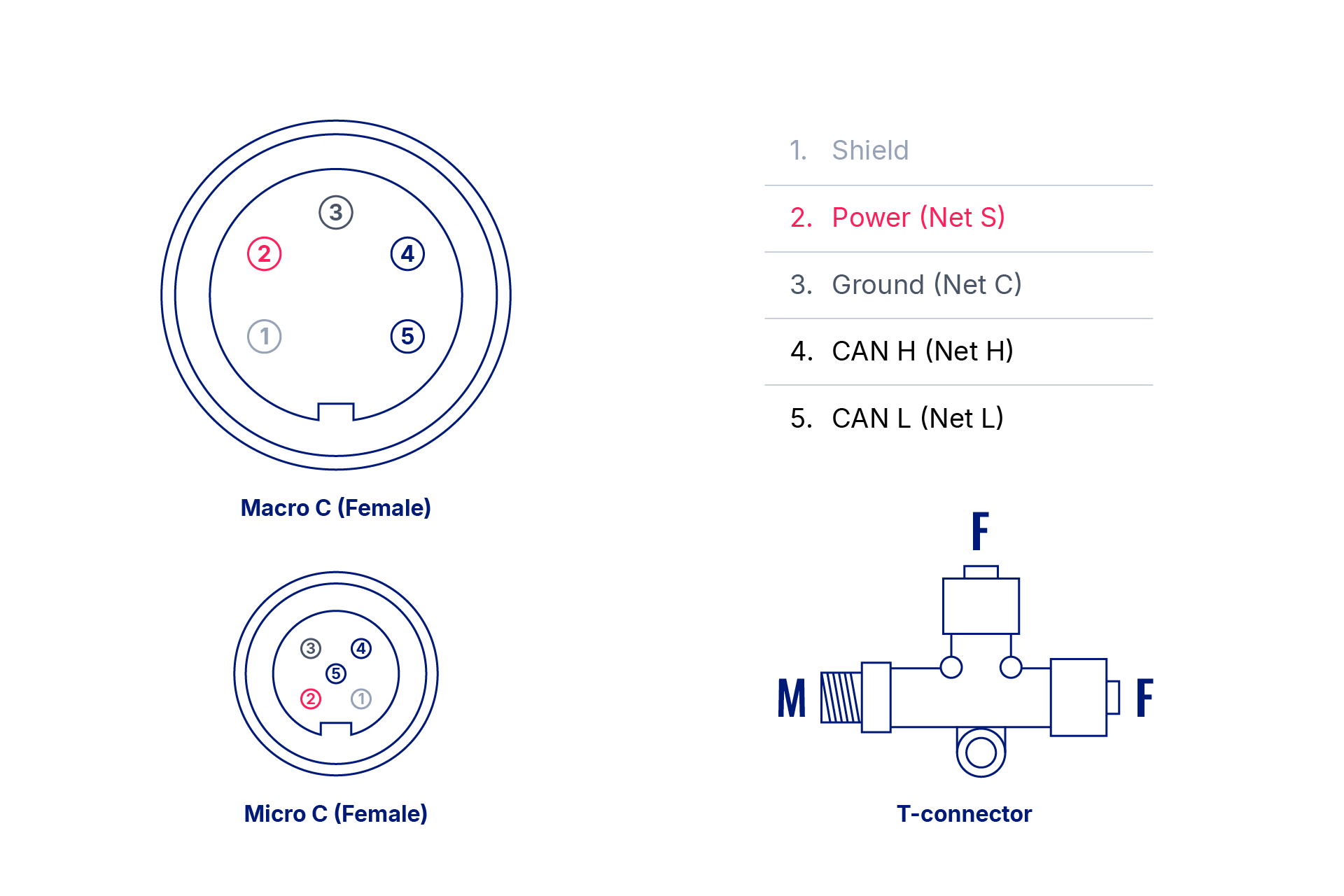
| PIN | Function |
|---|---|
| 1 | Shield |
| 2 | Power source (+) |
| 3 | Ground |
| 4 | CAN H |
| 5 | CAN L |
Method 2: NMEA 2000 Backbone wire connection
Connect directly to the backbone using:
- CAN1 H and CAN1 L wires
- Power source connection
- Ground connection

Important Note: The {{{model}}} is not a waterproof device. We strongly recommend installing it inside a custom waterproof enclosure to protect it from marine environments.
Configuration requirements
Network settings
Baudrate: The NMEA 2000 system operates exclusively at 250 kbps.
Termination Resistance: 120Ω termination resistors must be installed at both ends of the network.
{{{model}}} Resistance Setting: Disable the internal CAN resistance on the {{{model}}} to ensure proper network operation.

CAN Bus configuration
Configure the baudrate based on your connection method:
- If using CAN1 lines: Set baudrate to 250 kbps in CAN1 bus settings.
- If using CAN2 lines: Set baudrate to 250 kbps in CAN2 bus settings.
NMEA 2000 Source Configuration
- Navigate to the NMEA2000 tab.
- Configure the CAN source according to your physical connection (CAN1 or CAN2).

The “Engine Instance ID” parameter allows selection of a value from 0 to 255. However, according to the NMEA2000 protocol specification, the following values are reserved and should not be used:
- 253 – Reserved
- 254 – Error
- 255 – Not available
I/O Element Configuration
- Access the NMEA2000 I/O tab.
- Configure the I/O elements you want to collect from your vessel.
- In the General/Main window, select desired parameters:
- Fuel fluid levels
- Wind direction
- Water depth
- Additional environmental data
Engine Selection
- Use the engine number selector to choose which engine data to monitor.
- The system supports monitoring up to 4 engines simultaneously.
- Configure each engine's parameters individually as needed.

As an example, the following data is received:
0x11 0x6A 0x19 0x00 0x00 0x00 0x00 0x00
- Instance = (0x11 & 0xF0) >> 4 = 0x10 >> 4 = 1 → Data will be written to Fuel Fluid Level #2
- Type = 0x11 & 0x0F = 0x01 = 1
- Fluid level (raw) = 0x6A 0x19 = 0x1964 = 6500
- Value = 6500 * 4 / 1000 = 26 = 0x1A
If the “low level” or “high level” parameters are not set, the fluid level is calculated as:
Fluid Level = (Type << 12) | Value
= 0x1000 | 0x001A = 0x101A (Decimal: 4122)

But if “low level” or “high level” would be set, Type data will be ignored.

AVL ID lists
General AVL ID Lists
| Parameter name | AVL ID |
|---|---|
| Fuel Fluid Level | 10850 |
| Oil Fluid Level | 10851 |
| Oil Pressure | 10852 |
| Oil Temperature | 10853 |
| Engine Temperature | 10854 |
| Alternator Voltage | 10855 |
| Fuel Rate | 10856 |
| Engine Hours | 10857 |
| Coolant Pressure | 10858 |
| Fuel Pressure | 10859 |
| Engine Status 1 Warning | 10860 |
| Engine Status 2 Warning | 10861 |
| Engine Load | 10862 |
| Engine Torque | 10863 |
| Water Depth Transducer | 10864 |
| Trip Fuel Used | 10865 |
| Distance To Empty | 10866 |
| Trip Run Time | 10867 |
AVL ID list for engine selection
| Parameter Name | AVL ID Engine 1 | AVL ID Engine 2 | AVL ID Engine 3 | AVL ID Engine 4 |
|---|---|---|---|---|
| Oil Pressure | 10852 | 13601 | 13613 | 13625 |
| Oil Temperature | 10853 | 13602 | 13614 | 13626 |
| Temperature | 10854 | 13603 | 13615 | 13627 |
| Alternator Voltage | 10855 | 13604 | 13616 | 13628 |
| Fuel Rate | 10856 | 13605 | 13617 | 13629 |
| Hours | 10857 | 13606 | 13618 | 13630 |
| Coolant Pressure | 10858 | 13607 | 13619 | 13631 |
| Fuel Pressure | 10859 | 13608 | 13620 | 13632 |
| Status1 Warning | 10860 | 13609 | 13621 | 13633 |
| Status2 Warning | 10861 | 13610 | 13622 | 13634 |
| Load | 10862 | 13611 | 13623 | 13635 |
| Torque | 10863 | 13612 | 13624 | 13636 |
| RPM | 14216 | 14217 | 14218 | 14219 |
[[Category:{{{model}}} Manual]]