
Template:1-Wire Accessory: Difference between revisions
No edit summary |
No edit summary |
||
| Line 8: | Line 8: | ||
| RFID = RFID tags (by emulating them using iButton protocols). | | RFID = RFID tags (by emulating them using iButton protocols). | ||
}}<br> | }}<br> | ||
1-Wire {{{accessory}}} readers are a convenient way to implement driver authorization and other functionalities.<br> | |||
'''Use cases:''' | '''Use cases:''' | ||
* Immobilizer - prevent the starting of a vehicle without first scanning an {{#switch: {{{accessory}}} | * Immobilizer - prevent the starting of a vehicle without first scanning an {{#switch: {{{accessory}}} | ||
| Line 23: | Line 22: | ||
{{#switch: {{{accessory}}} | {{#switch: {{{accessory}}} | ||
| iButton = | | iButton = | ||
<table class="nd-othertables_2" style="width:100%; border-collapse: collapse;"> | |||
<tr> | |||
<th style="width:30%; vertical-align: middle; text-align: left;">NAME</th> | |||
<th style="width:30%; vertical-align: middle; text-align: left;">DESCRIPTION</th> | |||
</tr> | |||
<tr> | |||
<td style="vertical-align: middle; text-align: left;">Interface</td> | |||
<td style="vertical-align: middle; text-align: left;">1-Wire</td> | |||
</tr> | |||
<tr> | |||
<td style="vertical-align: middle; text-align: left;">Wiring</td> | |||
<td style="vertical-align: middle; text-align: left;">White = 1-wire signal, Brown = Ground</td> | |||
</tr> | |||
<tr> | |||
<td style="vertical-align: middle; text-align: left;">Case material</td> | |||
<td style="vertical-align: middle; text-align: left;">Plastic (polyacetal)</td> | |||
</tr> | |||
<tr> | |||
<td style="vertical-align: middle; text-align: left;">Ring material</td> | |||
<td style="vertical-align: middle; text-align: left;">Ferrite steel with chrome plating</td> | |||
</tr> | |||
<tr> | |||
<td style="vertical-align: middle; text-align: left;">Signal joint material</td> | |||
<td style="vertical-align: middle; text-align: left;">Brass with chrome plating</td> | |||
</tr> | |||
<tr> | |||
<td style="vertical-align: middle; text-align: left;">Fastening method</td> | |||
<td style="vertical-align: middle; text-align: left;">M12 screw</td> | |||
</tr> | |||
<tr> | |||
<td style="vertical-align: middle; text-align: left;">Wire dimensions 2 wires</td> | |||
<td style="vertical-align: middle; text-align: left;">Ø 0,25 mm2</td> | |||
</tr> | |||
<tr> | |||
<td style="vertical-align: middle; text-align: left;">Cable length</td> | |||
<td style="vertical-align: middle; text-align: left;">40 cm</td> | |||
</tr> | |||
<tr> | |||
<td style="vertical-align: middle; text-align: left;">Operating temperature</td> | |||
<td style="vertical-align: middle; text-align: left;">-40 ºC to +85 ºC</td> | |||
</tr> | |||
<tr> | |||
<td style="vertical-align: middle; text-align: left;">Operating humidity</td> | |||
<td style="vertical-align: middle; text-align: left;">Up to 70%</td> | |||
</tr> | |||
<tr> | |||
<td style="vertical-align: middle; text-align: left;">Supported by</td> | |||
<td style="vertical-align: middle; text-align: left;"><span class="mw-collapsible mw-collapsed"> [https://wiki.teltonika-gps.com/view/FMB110 FMB110], [https://wiki.teltonika-gps.com/view/FMB120 FMB120], [https://wiki.teltonika-gps.com/view/FMB122 FMB122], [https://wiki.teltonika-gps.com/view/FMB125 FMB125], [https://wiki.teltonika-gps.com/view/FMU125 FMU125], [https://wiki.teltonika-gps.com/view/FMM125 FMM125], [https://wiki.teltonika-gps.com/view/FMC125 FMC125], [https://wiki.teltonika-gps.com/view/FMB130 FMB130], [https://wiki.teltonika-gps.com/view/FMU130 FMU130], [https://wiki.teltonika-gps.com/view/FMC130 FMC130], [https://wiki.teltonika-gps.com/view/FMM130 FMM130], [https://wiki.teltonika-gps.com/view/FMB140 FMB140], [https://wiki.teltonika-gps.com/view/FMB202 FMB202], [https://wiki.teltonika-gps.com/view/FMB204 FMB204], [https://wiki.teltonika-gps.com/view/FMB640 FMB640], [https://wiki.teltonika-gps.com/view/FMC640 FMC640], [https://wiki.teltonika-gps.com/view/FMM640 FMM640] </span></td> | |||
</tr> | |||
</table> | |||
| RFID = | | RFID = | ||
{| class="wikitable" | {| class="wikitable" | ||
| Line 113: | Line 123: | ||
}} | }} | ||
==Installation== | ==Installation== | ||
''Note! This chapter describes the installation of an accessory supplied by Teltonika. Accessories from other manufacturers may require different steps. | ''Note! This chapter describes the installation of an accessory supplied by Teltonika. Accessories from other manufacturers may require different steps.<br> | ||
To connect the accessory to your system: | To connect the accessory to your system: | ||
# Connect the ground wire to the same grounding used for the device. | # Connect the ground wire to the same grounding used for the device. | ||
Revision as of 14:25, 30 January 2026
Introduction
1-Wire data protocol, implemented in many Teltonika devices, can be used to read
1-Wire {{{accessory}}} readers are a convenient way to implement driver authorization and other functionalities.
Use cases:
- Immobilizer - prevent the starting of a vehicle without first scanning an
- Authorized driving - keep track of who is driving the vehicle according to the they use to authenticate themselves.
- Auto Geofencing - get notified when a vehicle leaves a pre-defined area without authorization.
Specifications
}
Installation
Note! This chapter describes the installation of an accessory supplied by Teltonika. Accessories from other manufacturers may require different steps.
To connect the accessory to your system:
- Connect the ground wire to the same grounding used for the device.
- Connect the 1-Wire Signal wire from the reader to the 1-Wire Data pin on the device.
}
Tracker Configuration
The reader works as soon as it is connected, but the iButton isn't used anywhere other than displayed in the iButton I/O element. In order to use it for the Immobilizer scenario, the device must have the scenario enabled. Then, iButton check can be enabled to only accept iButtons specified in the iButton list under the 1-Wire tab.


Converting IO values to IDs
This short guide explains how to convert the iButton value in "I/O" menu to an ID usable in the iButton list in "1-Wire" menu. Note! For FMx6 trackers, you do not need to convert these values.
- Connect your 1-Wire accessory to the tracker according to the wiring scheme.
- Connect the tracker to a PC, run Teltonika Configurator.
- Open the "I/O" menu and find the "iButton" parameter.
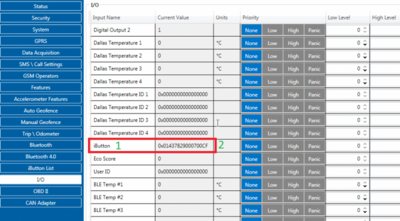
- Scan the 1-Wire accessory on the reader. The value in Configurator will shortly change.
- Take the value (here: 01437829000700CF) and convert it using the method shown below - then you will be able to use it in the iButton List.

