
Template:FMx650 TrailerCAN: Difference between revisions
No edit summary |
No edit summary |
||
| Line 69: | Line 69: | ||
The ISO 7638 7-pin socket can be used as a data source. Pins 6 and 7 are used for CAN data exchange between the truck and trailer, to which {{{model}}} CAN lines can be connected. Power supply can be taken from Pins 2 and 3. | The ISO 7638 7-pin socket can be used as a data source. Pins 6 and 7 are used for CAN data exchange between the truck and trailer, to which {{{model}}} CAN lines can be connected. Power supply can be taken from Pins 2 and 3. | ||
==Device Configuration== | ==Device Configuration== | ||
Currently, firmware version 03.01.01.Rev.03 can be used for trailer data reading, with the B.FMX6_R.167 configurator version to set up the device. Different truck manufacturers have different connection locations—baud rates may vary depending on the vehicle model. | |||
<gallery packed> | <gallery packed> | ||
Revision as of 10:50, 17 July 2025
This pages describes the TrailerCAN feature and gives related information.
Introduction
The Electronic Braking System (EBS) modulator is a key component in a trailer’s braking system. It not only controls braking performance but also ensures seamless communication with the connected truck. The global EBS modulator market is dominated by WABCO, Knorr-Bremse, and Haldex, each integrated into a wide variety of trailer types, including curtain siders, reefers, and flatbeds for numerous trailer manufacturers.
Because trucks, trailers, and EBS modulators are manufactured by different companies, ECE Regulation No. 13 and ISO 11992 global standards were introduced to ensure full compatibility. This standard is regularly updated and allows for smooth coupling between any truck and trailer, regardless of brand. It also standardizes data exchange and communication, making mixed-fleet integration much easier worldwide.
{{{model}}}, with its TrailerCAN feature, reads trailer data via CAN bus based on standardized regulations and provides it through I/O elements, enabling seamless integration with any fleet management platform. {{{model}}} is a powerful and versatile device that can gather trailer CAN data from multiple sources:
- Directly from the truck
- Straight from the EBS modulator
- Via the trailer socket
Truck and Trailer Coupling
Coupling of the towing truck and towed trailer is done according to ECE Regulation No. 13 and ISO 11992 standard.
CAN data between towing and towed vehicles is exchanged via the ISO 7638 7-pin socket.
-
 Coupling example (© Erich Jaeger)
 -
 Socket example (© Erich Jaeger)


| # | Function | Color |
|---|---|---|
| 1 | Plus electrovalve | Red |
| 2 | Plus electronics | Black |
| 3 | Minus electronics | Yellow |
| 4 | Minus electrovalve | Brown |
| 5 | Warning device control (normally open) | White |
| 6 | CAN_H | White/green |
| 7 | CAN_L | White/brown |
Physical Connection Options
1. {{{model}}} reading trailer data via the truck:
{{{model}}} is designed to read a coupled trailer‘s data from the truck itself. A connection can be made using the Teltonika ECAN02 adapter to avoid damaging wires or voiding the warranty. Connection schemes for different manufacturers, generations, and truck model years are in progress. You can contact our support team to get the guidelines for your specific truck.
Example:
-
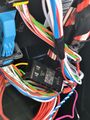 TrailerCAN connection to truck
 -
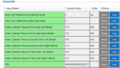 TrailerCAN connection to truck - Configurator


2. Direct connection to the EBS modulator:
{{{model}}} can be connected directly to the EBS modulator’s diagnostic line or another CAN line using a specific OEM cable from the manufacturer. Connection instructions and part numbers for OEM cables are being developed.
Example:
-
 TrailerCAN connection to EBS (1)
 -
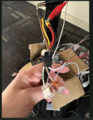 TrailerCAN connection to EBS (2)
 -


3. Connection via the ISO 7638 7-pin socket:
The ISO 7638 7-pin socket can be used as a data source. Pins 6 and 7 are used for CAN data exchange between the truck and trailer, to which {{{model}}} CAN lines can be connected. Power supply can be taken from Pins 2 and 3.
Device Configuration
Currently, firmware version 03.01.01.Rev.03 can be used for trailer data reading, with the B.FMX6_R.167 configurator version to set up the device. Different truck manufacturers have different connection locations—baud rates may vary depending on the vehicle model.
-
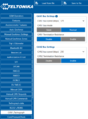 Configurator: CAN \ Tachograph settings
 -
 Configurator: TrailerCAN settings


AVL ID List
| AVL ID | Property Name |
|---|---|
| 13651 | Detected towed vehicle |
| 13652 | Trailer wheel based speed |
| 13653 | ABS status |
| 13654 | Retarder control status |
| 13655 | Red warning signal request |
| 13656 | Amber warning signal request |
| 13657 | Axle load sum |
| 13658 | Retarder wheel torque reference |
| 13659 | Service brake status |
| 13660 | Electrical supply status |
| 13661 | Vehicle type |
| 13662 | Axle load measured by towed vehicle |
| 13663 | Axle load measured by external scale |
| 13664 | Calibration data load level |
| 13665 - 13670 | Brake cylinder pressure of each wheel |
| 13671 | Trailer VIN** |
| 13672 | VDC active |
| 13673 | Lateral acceleration |
| 13674 | Loading ramp approach assistance status |
| 13675 | Supply line braking |
| 13676 | Stop lamps request |
| 13677 | Braking via electric control line support |
| 13678 | ROP system status |
| 13679 | YC system status |
| 13680 | Traction help status |
| 13681 | Lift axle 1 position status |
| 13682 | Lift axle 2 position status |
| 13683 | Steering axle locking status |
| 13684 - 13698 | Each wheel tire pressure status* |
| 13699 - 13713 | Each wheel tire pressure* |
| 13714 - 13728 | Each wheel brake lining status* |
| 13729 - 13743 | Each wheel brake lining* |
| 13744 - 13758 | Each wheel brake temperature status* |
| 13759 - 13773 | Each wheel brake temperature |
| 13774 | Vehicle pneumatic supply status |
| 13775 - 13789 | Each wheel air leakage detection* |
| 13790 - 13804 | Each tire temperature* |
| 13805 | Automatic towed vehicle braking status |
| 13806 | Electrical supply of non-braking system status |
| 13807 | Spring brake installation status |
| 13808 | Electrical load proportional function installation status |
| 13809 | Spring brake status |
| 13810 | Pneumatic supply pressure |
(*) Some parameters might not be available if the trailer is not fitted with a TPMS system or the required sensors.
(**) The trailer can provide the full VIN number, or only a partial one (equipment number/chassis number/serial number).

